
Poland's regional rail network spans well over ten thousand kilometres of track and traverses terrain that changes markedly between voivodeships. The routes described below are selected for geographical variety — they cross river valleys, forest regions, and upland terrain — rather than for operational frequency or comfort classification.
Kraków–Zakopane: The Southern Approach
The line connecting Kraków to Zakopane in the Tatra foothills is one of the more discussed rail corridors in southern Poland. Trains depart from Kraków Główny and travel south through Myślenice and Rabka-Zdrój before reaching the terminus. The section between Sucha Beskidzka and Rabka offers views across the Beskid Makowski range.
Journey times vary depending on the number of intermediate stops. Polregio and Koleje Małopolskie operate services on this corridor. The route passes through several smaller spa towns — Rabka-Zdrój has been a designated health resort since the nineteenth century — which adds a historical layer to the journey.
The Bieszczady Narrow-Gauge Line

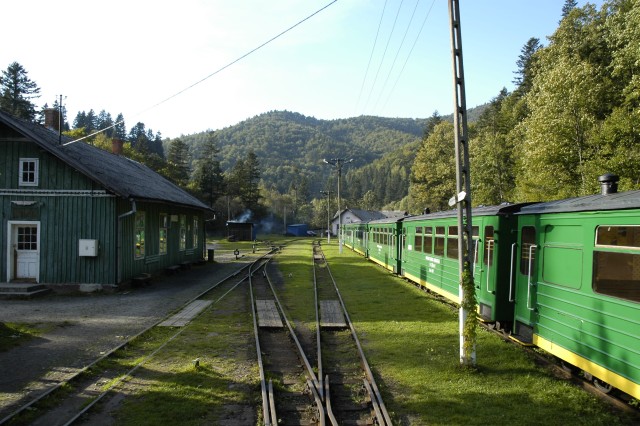
The Bieszczady Forest Railway (Bieszczadzka Kolejka Leśna) operates on 750 mm narrow gauge track in the southeastern corner of Poland, within the Bieszczady National Park buffer zone. Unlike standard regional services, this line functions primarily as a heritage and tourism railway during the summer season.
The railway runs from Majdan to Balnica and several branch points, with the main section passing through dense mixed forest along the San river valley. The landscape is characteristic of the Outer Eastern Carpathians — wide valleys separated by low rounded ridges, largely undisturbed by industrial development.
Operational details, including seasonal timetables, are published by the Bieszczady Forest Railway foundation. The line is one of few surviving examples of narrow-gauge forest railway operation in Poland.
Practical notes
- Services run seasonally, typically from May through October.
- The nearest standard-gauge station is Zagórz, served by trains from Sanok and Rzeszów.
- There is no direct through connection between standard and narrow gauge; passengers change at Majdan village.
Trójmiasto to Hel: The Baltic Peninsula
The rail line running along the Hel Peninsula from Gdynia Główna to Hel is geographically distinctive — the track runs along a narrow sand spit between the Gulf of Gdańsk and the open Baltic Sea. In places the land is less than a kilometre wide, making this one of the more unusual rail alignments in Central Europe.
PKP Intercity operates seasonal express trains on this route in summer; regional services by Polregio run year-round with more stops. The journey from Gdynia to Hel takes roughly two hours on stopping services. Intermediate stations include Wejherowo, Puck, and Władysławowo.
The line passes through protected coastal landscape. The peninsula itself is part of the Trójmiejski Landscape Park buffer and the coastal area is a significant bird migration corridor, which has been documented by ornithological stations at Hel since the mid-twentieth century.
Wrocław–Jelenia Góra: Lower Silesia Uplands
Koleje Dolnośląskie operates regular services between Wrocław and Jelenia Góra, covering approximately 120 kilometres through the Lower Silesian lowlands and then into the Sudeten foothills. The section from Legnica to Jelenia Góra passes through the Bóbr valley, where the line follows the river through increasingly elevated terrain.
Jelenia Góra serves as a practical base for exploring the Karkonosze range and the historic spa town of Cieplice Śląskie-Zdrój. The station building at Jelenia Góra dates from the early twentieth century and retains much of its original structural fabric.
Gdańsk Główny to Malbork: The Vistula Delta Approach
The main line between Gdańsk and Warsaw passes through Malbork, crossing the Nogat river — a distributary of the Vistula — on a bridge immediately adjacent to Malbork Castle. On this stretch, the train passes within a few hundred metres of one of the largest Gothic brick structures in Europe, offering a brief but direct view from the carriage window.
PKP Intercity operates several daily intercity connections along this corridor. Regional stopping services also use parts of the route, giving access to smaller settlements in the Żuławy Wiślane, the historically distinctive delta plain of the lower Vistula.
Planning Regional Rail Journeys in Poland
The national journey planner at rozklad-pkp.pl covers all operators and allows seat reservation for Intercity services. For regional services, individual operator websites sometimes carry more complete information on specific lines, especially where timetables change seasonally.
Rail passes valid in Poland include the Interrail and Eurail Europe-wide products, as well as bilateral passes for certain country combinations. Polregio operates a network discount pass (Bilet Sieciowy) for frequent regional travellers.